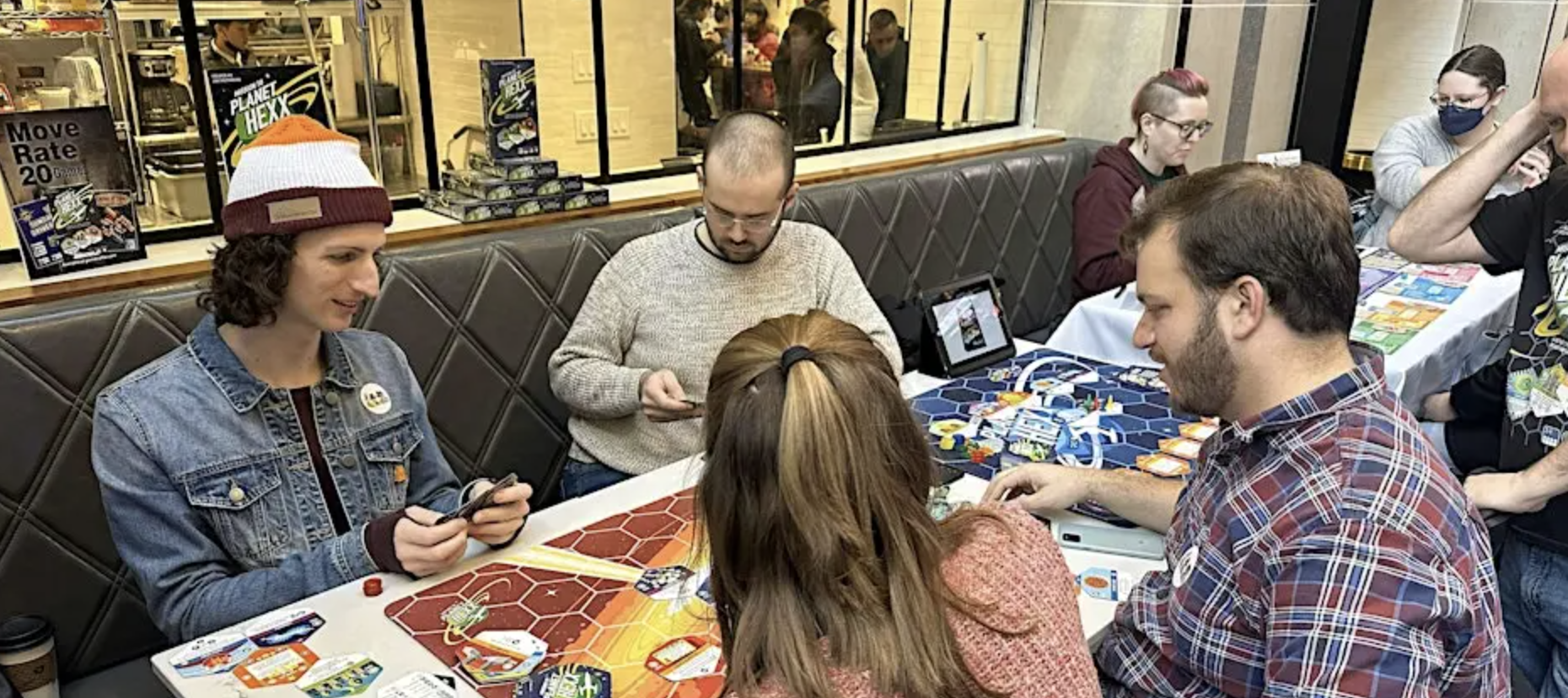
I didn’t think I would have enough news about Office Orcs to warrant an update before PAX East, yet here we are! A lot has changed with the game in the last two months and I’m excited to share it all with you. A lot of the new are direct suggestions from people who have reached out or helped play-test previous iterations of Office Orcs, so thank you very much! Anyway, let’s get right into it.
New Art!
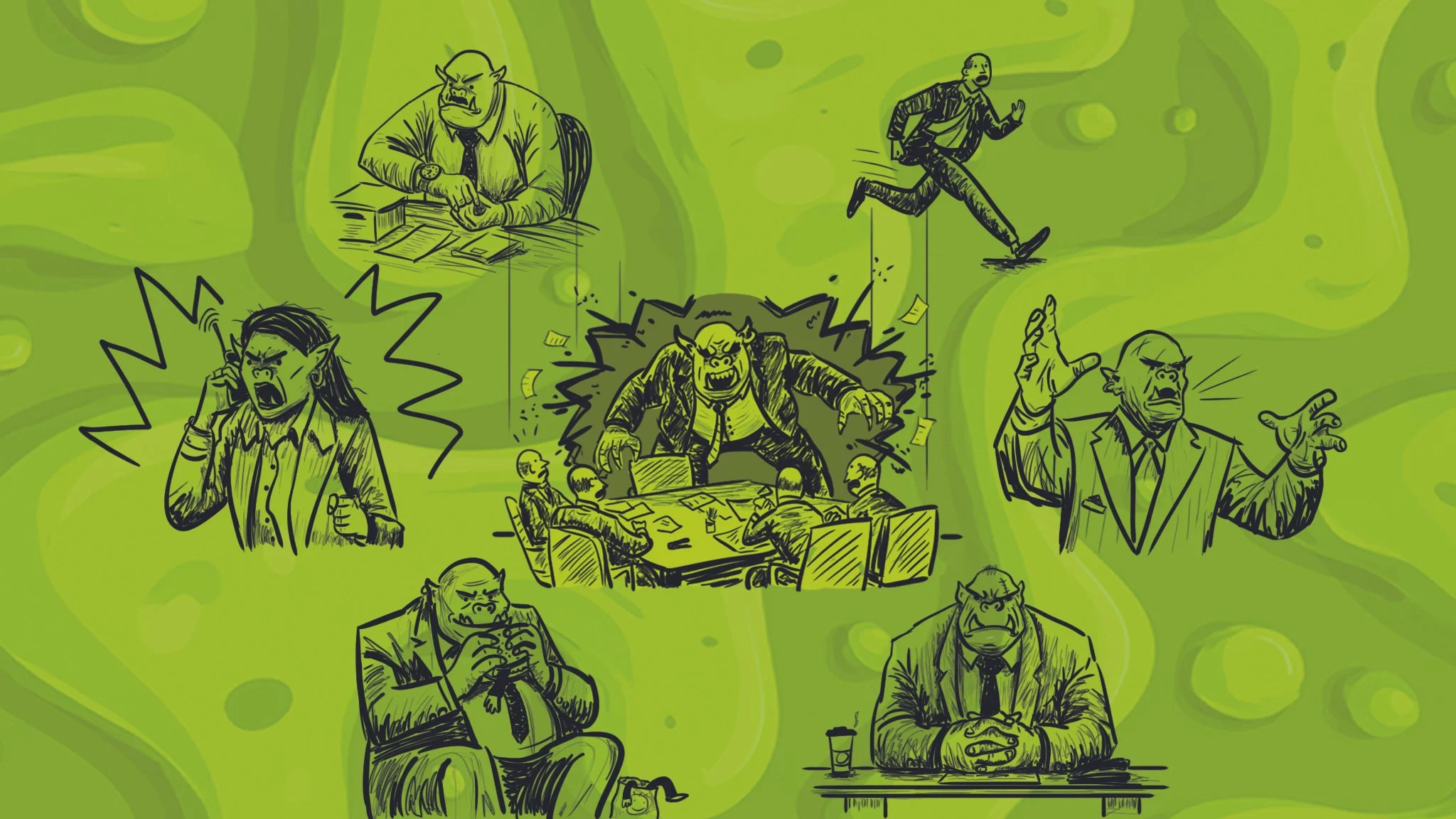
Probably most apparent, there is now a new look for the game, all drawn by me! Early on in the prototyping phase I used Mid-Journey and stock images from Google to quickly get some art assets onto the cards just to have something for people to look at while playing. I personally am very visually oriented, so even though the game would have been totally functional with no art, the silly tone of the game conveyed through its imagery would not have been as obvious as I wanted it to be during testing.

This is slop.
AI in boardgames is a very contentious subject matter right now. If you go onto any tabletop or boardgame design forum right now you will find post after post of prototypes with AI generated art. The word “slop” gets inevitably thrown around in the comments in a negative way. To make my feelings clear here, I agree that “slop” is the right word. Again, prior to this point in my prototyping process for Office Orcs I was also making use of said slop, and I don’t deny that. However, prototyping is an iterative process, and at no point did I ever desire or plan that the imagery of whatever AI slop some algorithm generated for me would end up in a final product that could have my name on it. I think my main point here is that game designers (really all designers) need to be upfront and transparent with where AI may enter their process. Before each early prototype play session of Office Orcs I would let people know that I did not draw the art on the cards, it is temporary and will change. At the end of the day people just don’t want to be misled about effort within creative endeavors. Making art is what makes us human, being cagey about the process betrays us all.
While I am happy I reached the point where I was able to jettison the slop off of my game, I think designers do need to acknowledge the ability of AI tools as potential brainstorming assistants. A blank page, canvas, or design sheet can be very intimidating when starting fresh. In a perfect world, maybe you have your must trusted collaborators in the room to spitball ideas with, or endless time to mull over a single idea. We do not always have this luxury. This is where I think designers can interact with AI in a healthy way. When I was in art school, we tried a variety of different brainstorming “games” for projects, word association, mind mapping, starbursting, etc. AI is just another tool that can be used (not solely) at this phase of the creative process. But proceed with caution. We are doing ourselves a disservice believing that whatever text or image AI spits out is the end result of a “creative” process, rather than just a piece of scrap paper with some gibberish notes we can throw to the side along with our doodles once the real art is being made. AI output is inherently disposable.
Sorry, got a little preachy there. But beyond AI it’s important to remember that this new art isn’t even the end all in the first place. If my game is picked up by a publisher I fully expect it to be redone by an illustrator or totally reskinned. Until this game is published, everything is temporary and I’m not married to any one idea or piece of art. Some other designers would say I already invested too heavily into the art this early on. All I can say to that is I drew it all myself so I didn’t have to pay anyone, and I had fun doing it, so oh well, I had a good time.
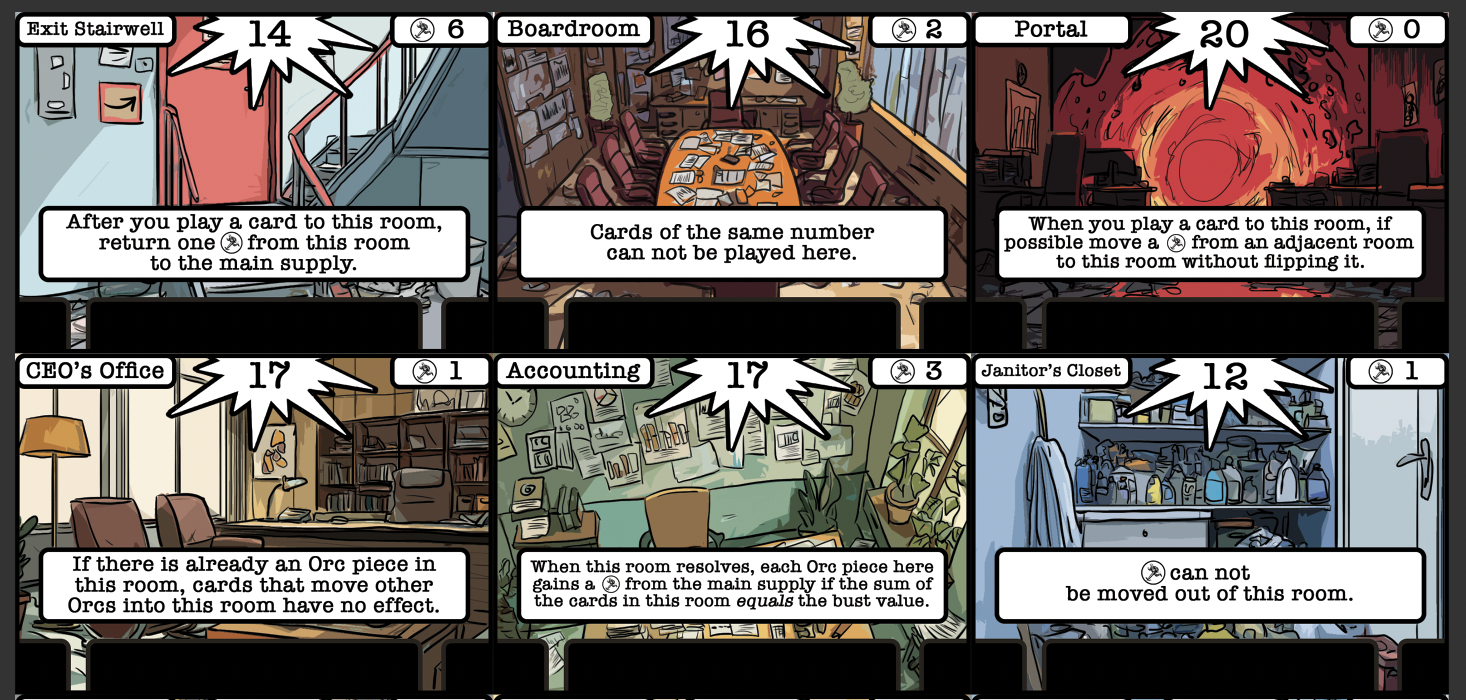
Quick room sketches with some color. I did 16 of these…
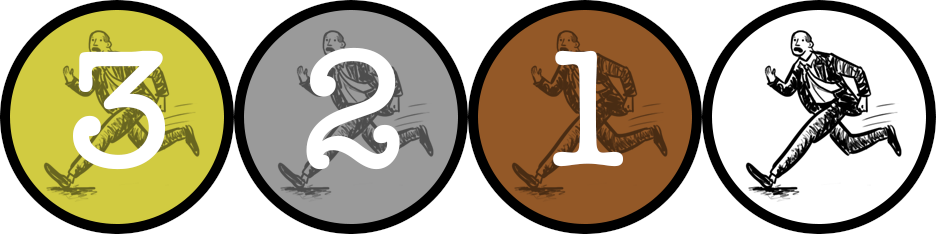
Variable Point Value Tokens
A problem I had in previous iterations of Office Orcs was when a player was doing very well and starting to run away in points, it became obvious that no one else was going to be able to catch up. Each businessman you ate was always just 1 point and because a different amount of businessmen come out each round, there were instances where playing the final round of the game didn’t even matter as the total available points to score in that round could not put anyone else past 1st place.
While at Boston’s EverWinter convention in December, it was suggested to give the Businessman secret point values that are revealed at the end of the game. I thought this was a fun idea that could also add some more decision space to the game without adding too much complexity. I worked on a number of versions of Office Orcs that had different end game scoring mechanics over the holidays.
The Businessman were originally cubes, so first I replaced them with tokens that had hidden values of 1 or 2 points. This helped keep players engaged in the final round when there was a big lead, but even then the point variability was not enough to truly obfuscate the final scoring in a meaningful way. Adding a smaller amount of 3 point tokens helped some more, but then made the game feel too luck based if you happened to get a 3.
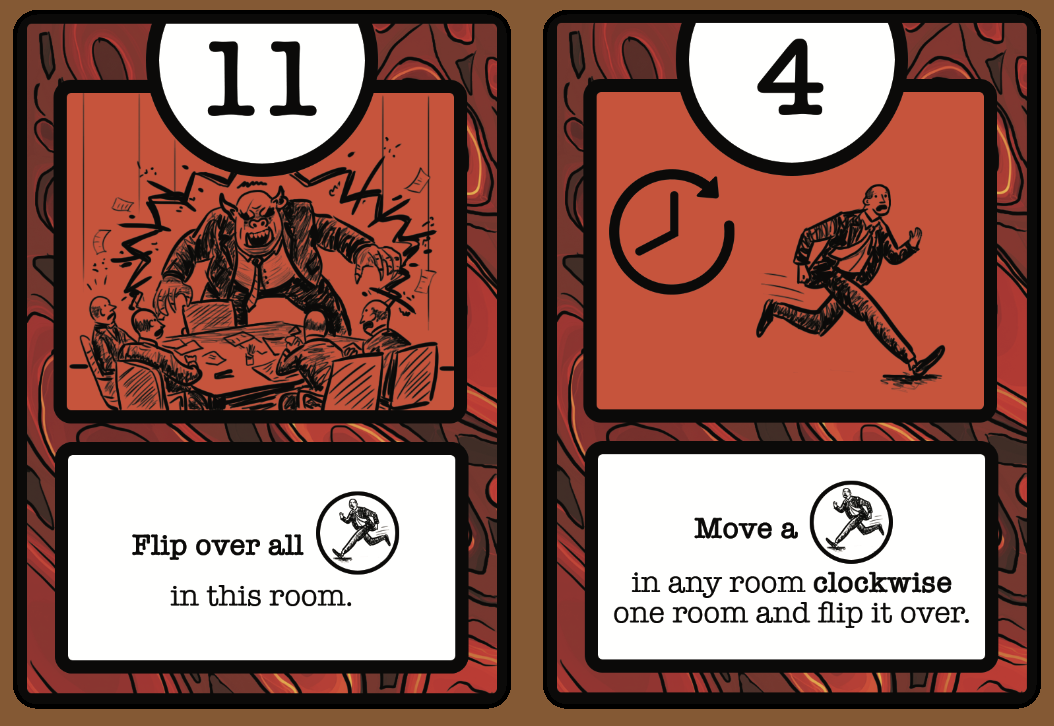
The breakthrough was when I started experimenting with having the point tokens flip over if they are moved. This provides a nice pull and push when moving tokens, as before a player moving a token usually only benefited that specific player, however moving it now reveals its value benefiting every other player as well. Even better was allowing the tokens to flip multiple times, allowing for some interesting plays where even though you may be unable to score points on a turn you can make it harder for another player to score big points by hiding tokens with larger values among smaller ones.
Currently with these new rules, when picking tokens it is always best to pick a face-down token if there are only 1’s visible because it might be a 2 or a 3. However I am just now experimenting with a new rule that when players lose tokens for whatever reason, they must lose their facedown tokens first. Do you take the safe 1 point token that you can’t lose? Or do you take a face-down one and hope you don’t lose it on a later turn.
All in all, I’m very excited about this new mechanic. Games have been much more interesting in the final round, as players are checking their count of tokens against everyone else’s trying to see who has the most face-down tokens and might score big end game points. It also creates some fun moments when a 3 point token is revealed and everyone starts rushing and fighting over space in the room that it’s in.
End of Round Objectives
While the variable tokens are great, I still wanted something a little extra that could spice the game up when scoring points. I was looking through my game collection and thinking about what games handle the end game interestingly, but as simple as possible. It’s a little cliche now but I kept coming back to Ticket to Ride.
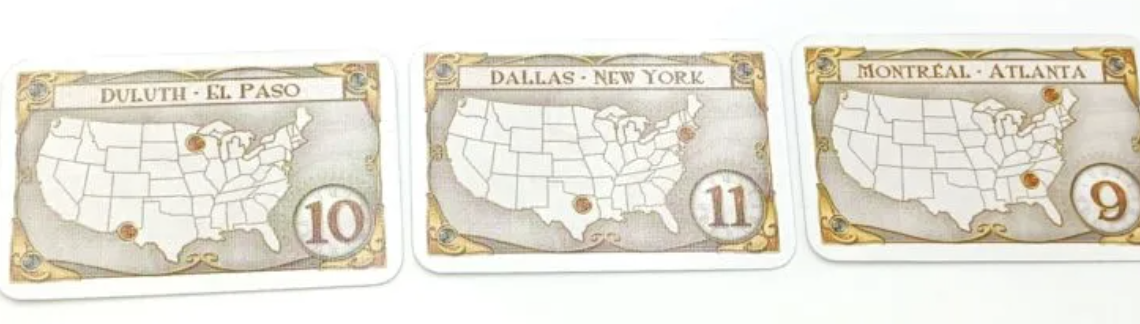
I think Ticket to Ride was the first game that I played that had end game scoring cards. Basically at the beginning of the game you can secretly pick a complicated train route to complete, if you build it you get a lot of extra points, if you don’t you lose points. This is great. It’s easy to explain, but more importantly it also provides some guidance to new players on something to aim for. If your first turn feels overwhelming and you have analysis paralysis, take a glance at your end game scoring card and it will literally give you a suggestion of what you should do on your first turn. I had noticed this feeling from players in my own game. Giving them something to aim for would not only speed up play at the beginning of the game, but also allow for more surprising moments during end game scoring as well.
I also liked how in Ticket to Ride, you can get more of these end game cards if you want, you’re not stuck with just one. My game is much faster than Ticket to Ride so I shortened the requirements from end game scoring to end of round scoring, allowing for multiple opportunities to get points in alternative ways as opposed to just eating businessmen. Then I set to work making the cards.
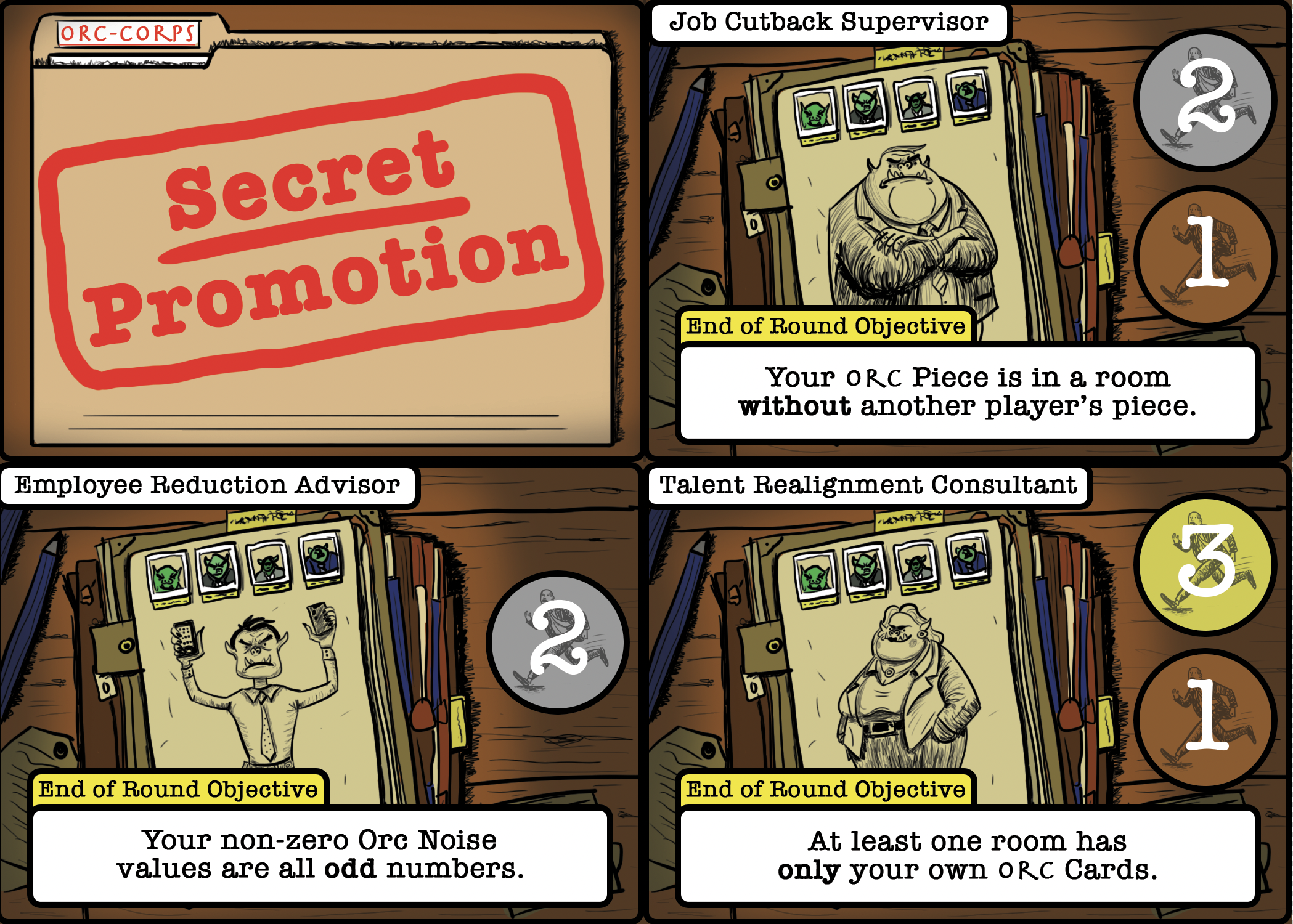
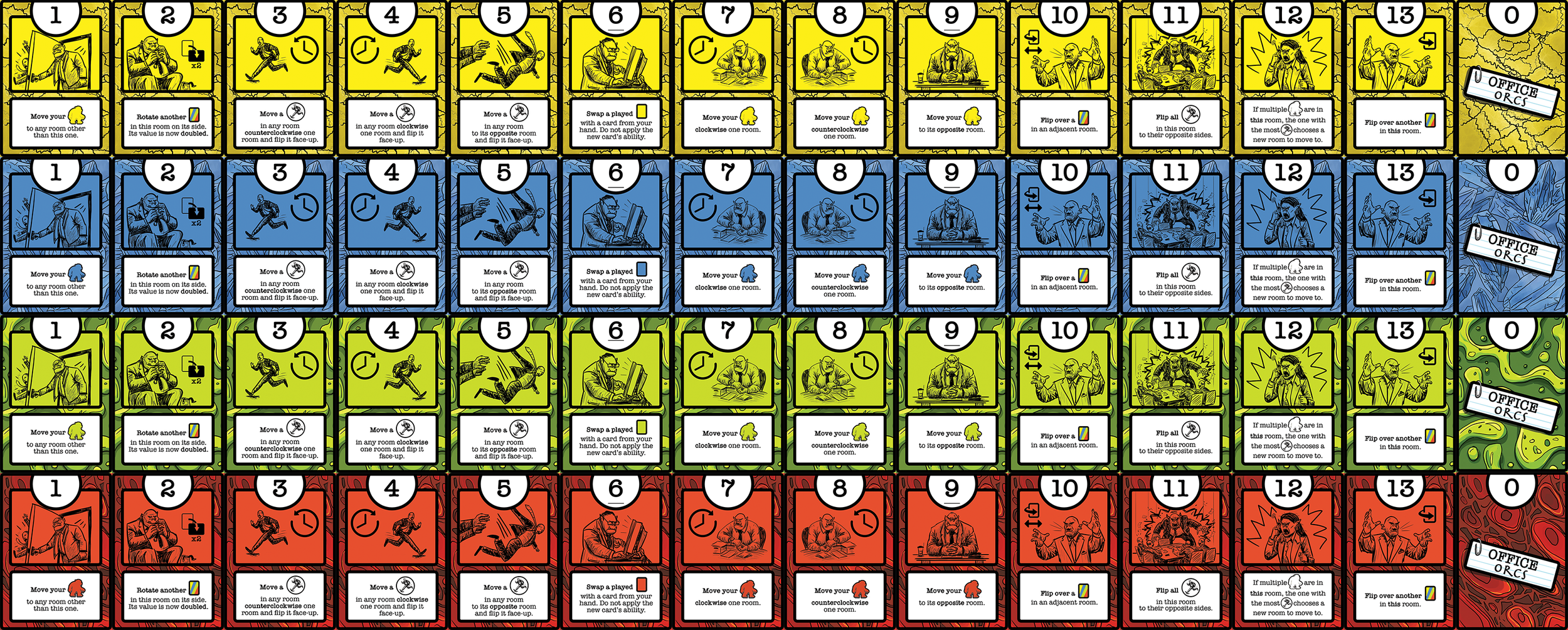
Some examples of Secret Promotions you may score at the end of a round.
Wow! What a difference this has made to the game. Not only are the end game point reveals more dramatic, but it has made the turn by turn play much more interesting as well. Before players had to chose between maybe 3 potential good plays on their turn, with each play being completely reliant on Businessman placement. Now turn actions can become much more unexpected as players do weird things to meet their end game objectives. There is also a nice tension when deciding on your own turn what to do. Do I eat some guaranteed Businessman for small points now? Or do I leave them and instead try to get these big points at the end of the round. The more interesting the decisions, the more interesting the game! I also had a lot of fun coming up with these card names as well if you couldn’t tell.
Whats Next?
Balancing, balancing, balancing. I think I’m at the point where I don’t want to add anything else to the game. Office Orcs is a small box card game, and introducing any more complexity would clash with the expectations the game gives off visually and in it’s theme. Now it is time to test and keep testing. There is a lot of math to balance here. Getting the point values correct on the End of Round objectives has been difficult. The easy objectives should have less points than the hard objectives, but sometimes easy/hard is subjective depending on who is playing. When I’m not testing with real people I’m testing it on my screentop prototype and keeping track of wins, losses, points, objectives… it’s a lot. I’ll get there.
Contests!
Another reason for now getting rid of any imagery that I did not personally create was to start submitting to contests! I didn’t feel comfortable submitting my game while there was still stuff in it that could be considered “slop”. If I’m going to lose or win, I want it to be with stuff that I alone made. Submitting to contests with AI imagery is unacceptable, and I hope the contest organizers feel similarly. So far I have submitted to Cardboard Edison, the Boulogne-Billancourt Contest, and the Swedish Annual Game Design Contest. Watch my 3 minute pitch video here: https://www.youtube.com/watch?v=fIFBiPFSceo
Indie Board Game Showcase
I was also accepted to demo Office Orcs at the Indie Board Game Showcase at High Street Market in Boston on February 21st! I have attended this showcase for the last 3 years, but this will be my first time as a designer. It’s in a food hall which sounds like an odd place to play games, however you do get some people who might not usually play boardgames walk by and it’s a good way to network and pitch your game outside of your comfort zone. If you’re in town I hope to see you there, stop by and say hi! You can use my coupon code GLASER at checkout to save some money on tickets too.